Our Project
To test the reliability of Unmanned Aircraft Systems equipped with advanced imaging systems for detecting unexploded ordinance in the field, we will explore a variety of conditions and how they may affect the detection ability. We plan to simulate landmine casings of three different materials: plastic, aluminum, and steel. In addition, each material will be simulated in three different shapes. The shapes will focus primarily on common anti-personnel mines. Each of these materials and sizes will be tested both above ground and at a depth of two inches, common placements of landmines. We will have two testing areas, one kept clean to simulate newly laid landmines, and one allowed to become overgrown to simulate how time may affect detection capabilities.
For each test, we will measure a variety of variables and explore how these variables may have affected any changes in our detection capabilities. These variables include High and Low and current temperatures of the day, humidity, wind speed, UV index, soil saturation, grass height, as well as flight speed and altitude.
By testing these various conditions, we hope to determine the reliability of using Unmanned Aircraft Systems with advanced imaging systems for detecting unexploded ordinance and perhaps, create a standard operating procedure for future use.
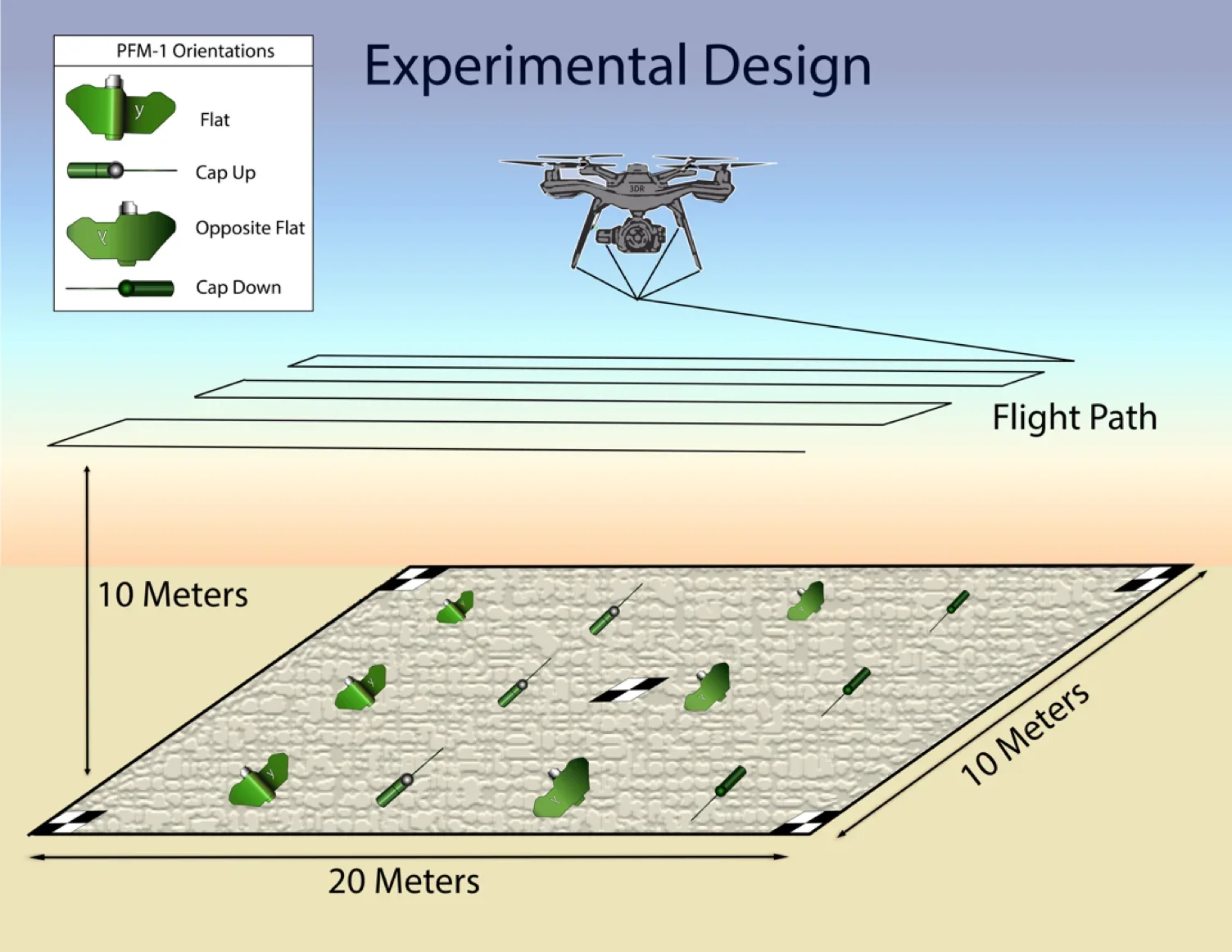
Nikulin, A., De Smet, T. S., Baur, J., Frazer, W. D., & Abramowitz, J. C. (2018). Detection and Identification of Remnant PFM-1 ‘Butterfly Mines’ with a UAV-Based Thermal-Imaging Protocol. Remote Sensing, 10(11), 1672. https://doi.org/10.3390/rs10111672
An example of what our final product will be able to accomplish, flying preset patterns and using IR cameras to detect hotspots, then marking those targets as candidates using machine learning programs
Replica Landmine Specifications
Plates of various materials and thickness were cut into three shapes imitating the anti-personnel landmines utilized in the past by the US Armed Forces and currently by the Armed Forces of the Russian Federation. The replica mines were spray painted with a uniform satin color in attempt to match the ground color, similar to how landmines are painted to blend into the environment they’re utilized in. Each replica mine was labelled with an alpha-numeric identifier corresponding to the information below.
The plates materials and thickness are as follows.
A) A polycarbonate plate 7/32-inches in thickness.
B) An aluminum plate 1/32-inches in thickness.
C) An aluminum plate 1/4-inches in thickness.
D) A steel plate 3/16-inches in thickness.
E) A steel plate 3/32-inches in thickness.
The size and shape of the replicas are as follows.
1) A 5-inch by 2.5-inch rectangle simulating the Russian PFM-1S anti-personnel mines.
2) A 4-inch diameter circle simulating the US M-16 anti-personnel mines.
3) A 2.5-inch diameter circle simulating the US M-14 anti-personnel mines.
February 19th, 2026
Temperature at time of testing: 77°F
Feels like: 75°F
Humidity: 58%
Precipitation: 0-inches
Sunrise (CST): 6:34 am
Sunset (CST): 5:43 pm
Test Time: 5:30 pm
Pressure: 29.67 inches of mercury
Grass height: 2 inches
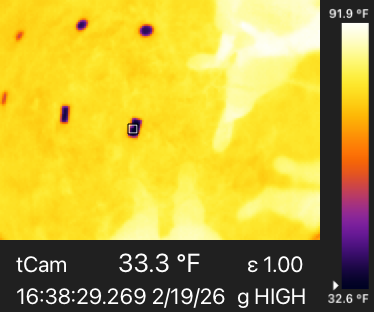
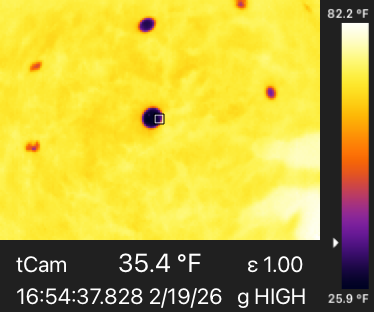
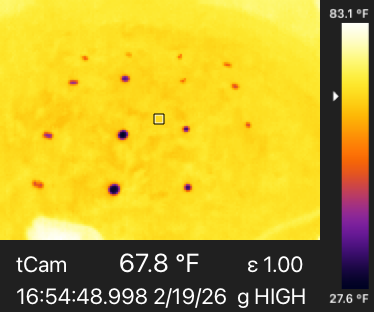
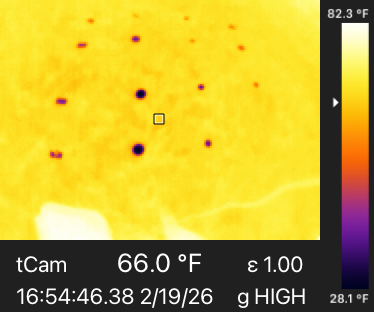
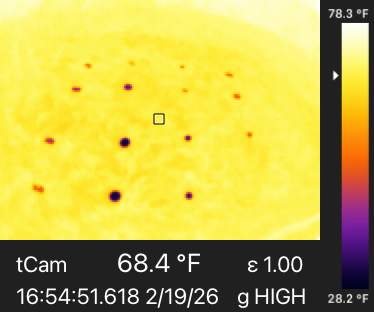
At this point the team was still calibrating the thermal camera and the temperatures recorded were inaccurate. However, it should be noted that the mines still showed colder than the ambient ground and air temperature. This test also showed that the properly sized test mines could still easily be picked up by the thermal camera. The temperature at the time of the test was 77°F. This combined with the thermal camera reading target temperatures of ~34°F showed that the inaccurate temperatures were still being reported for the materials even though, in the images, the surrounding soil was a plausible temperature.
February 23rd, 2026
Temperature at time of testing: 41°F
Feels like: 35°F
Humidity: 39%
Precipitation: 0-inches
Sunrise (CST): 6:30 am
Sunset (CST): 5:47 pm
Test Time: 5:30 pm
Pressure: 30.4 inches of mercury
Grass height: 2 inches
Site 1
Site 2

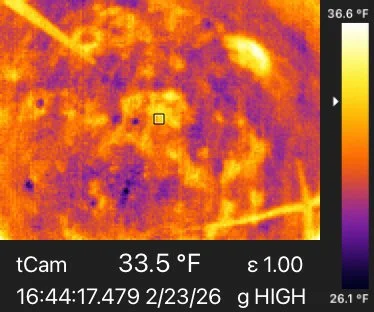
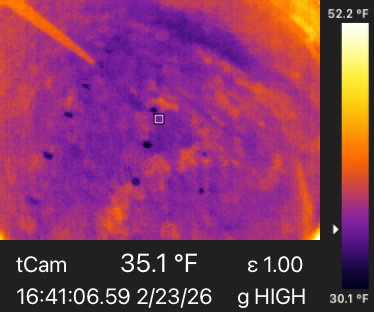
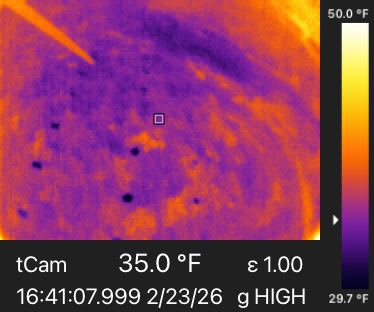
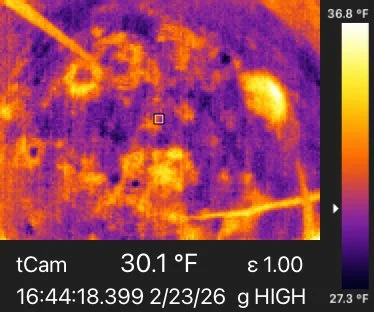
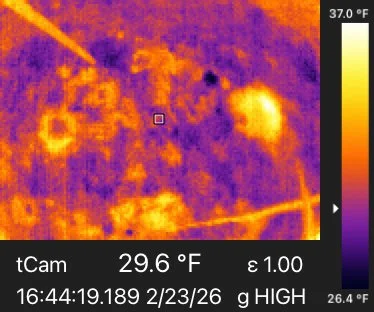
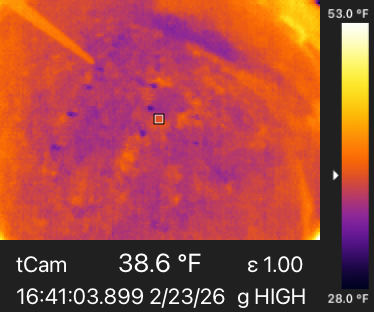
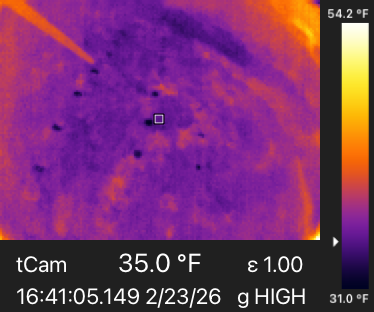
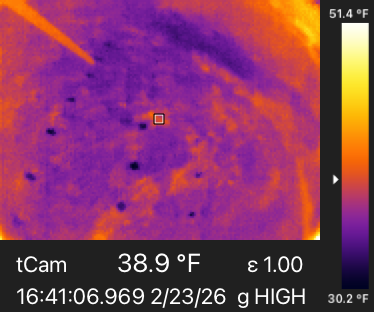
This test was the first in which the mines were painted on one side to better resemble a real mine’s color and reflectivity. The mines were still easily detectable after having been painted. It should be noted that the temperature this day was significantly colder than previous tests, with the temperature at the time of testing being 41°F and the morning having been below freezing. Later tests will show that the average temperature and cloud cover could have played a role in the images’ readability. This was also the first test in which the thermal camera displayed accurate temperature results verified by a secondary thermometer and the ambient temperatures
February 27th, 2026
Temperature at time of testing: 69°F
Feels like: 69°F
Humidity: 38%
Precipitation: 0-inches
Sunrise (CST): 6:25 am
Sunset (CST): 5:50 pm
Test Time: 5:30 pm
Pressure: 29.97 inches of mercury
Grass height:
Site 1
Site 2
Others
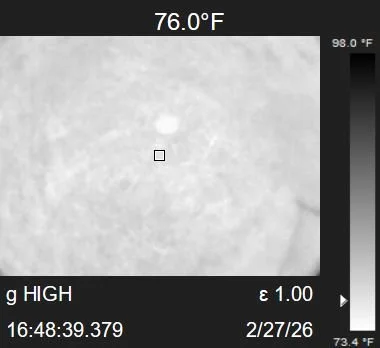
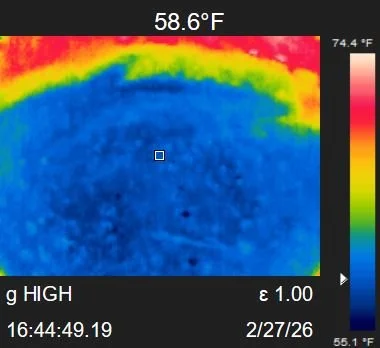
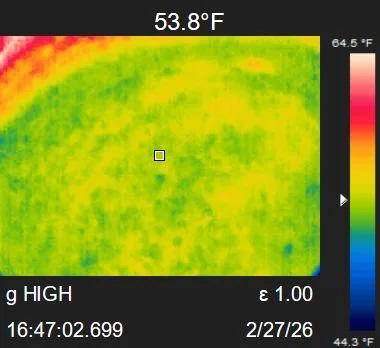
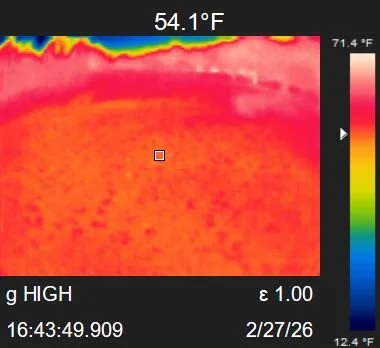
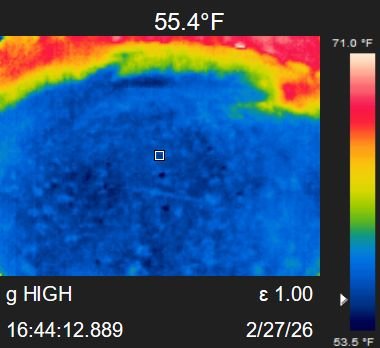
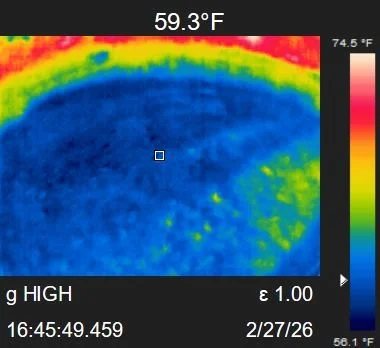
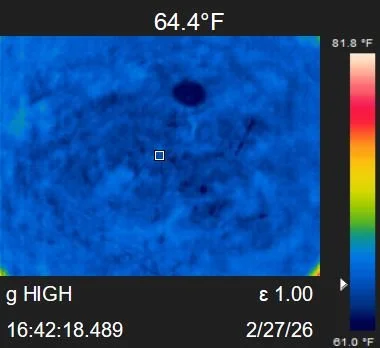
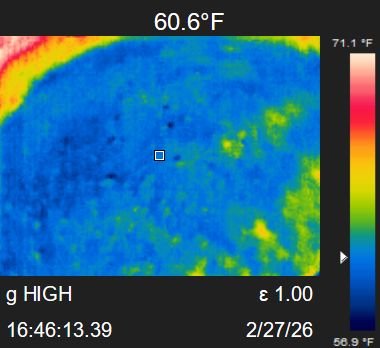
Test 4 was the same test set up as Test 3. The main difference being that the ambient temperature was much higher than the previous test at ~69°F. As seen in Figure 4, this test was when the effect of the paint on the thermal reflection started to become more noticeable in higher ambient temperatures. The individual mines are much harder to pick out from the still images but can still be identified. During this test, the team experimented with focusing on individual mines at much closer distances to see if greater clarity could be achieved. As can be seen in the third and fourth images of Figure 4, the closer images are much clearer. It was at this point in the project that the team began further researching ways to calibrate the thermal camera to increase visual fidelity
March 19th, 2026
Temperature at time of testing: 73°F
Feels like: 77°F
Humidity: 47%
Precipitation: 0-inches
Sunrise (CST): 6:58 am
Sunset (CST): 7:06 pm
Test Time: 5:35 pm
Pressure: 30.1 inches of mercury
Grass height:
Site 1
Site 2
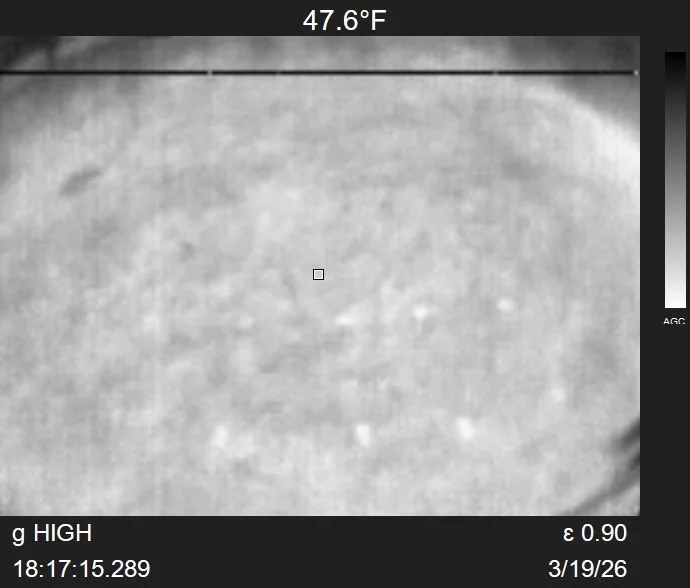
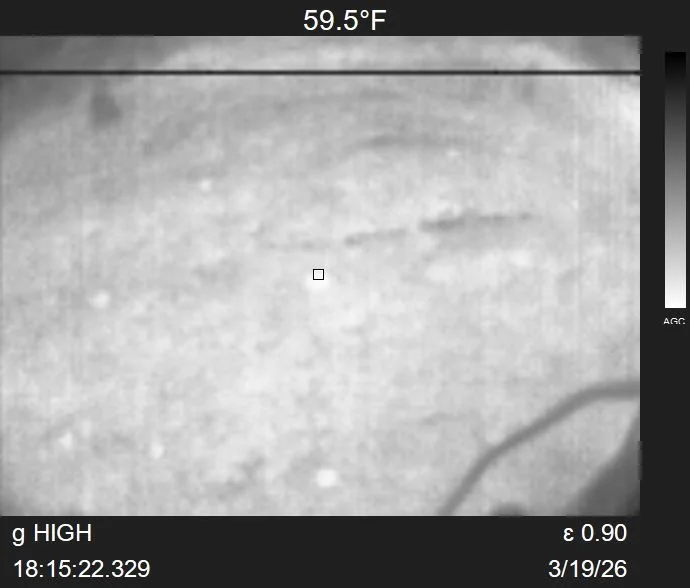
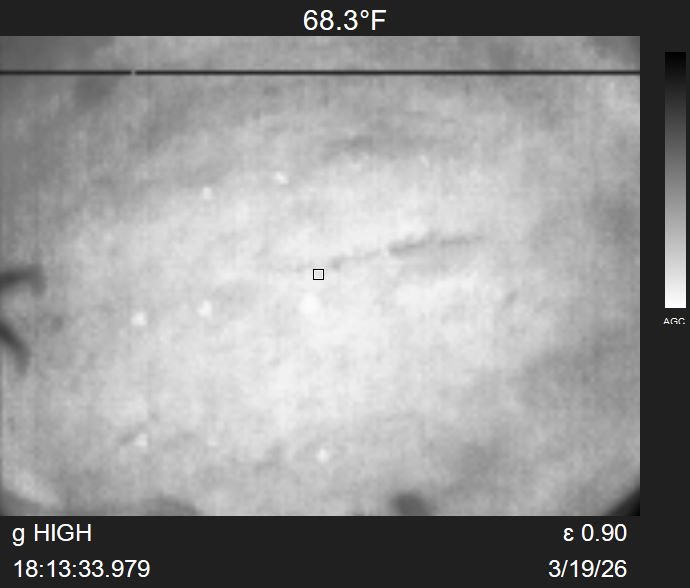
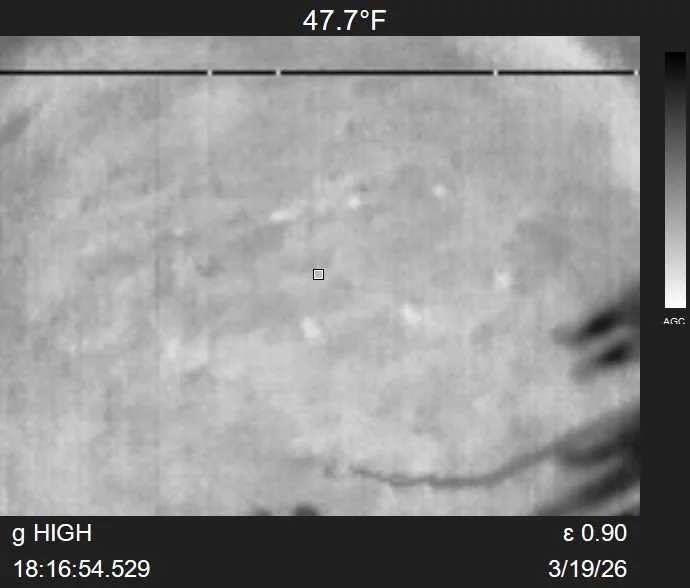
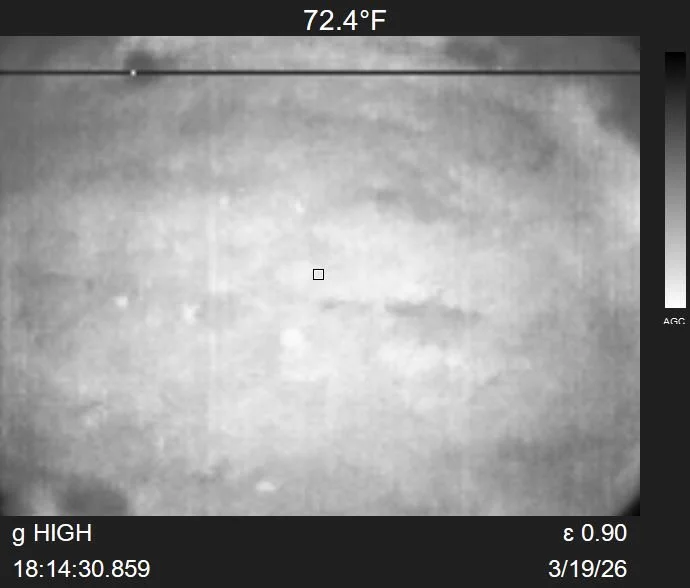
For this test the emissivity value on the thermal camera was altered to try to achieve better visual clarity, as the different materials and paint reflect the infrared signals at various strengths. It was the teams’ hope for this test that changing the emissivity to be more in line with a specific material would allow it to better stand out in the thermal images. Based on the results of the test shown in the images above, it is difficult to tell whether the emissivity level made certain materials any more identifiable than others. Overall, this test resulted in slightly less clarity, possibly due to the higher ambient temperature at ~73°F. During this test the team also began to have difficulties with the thermal imaging software provided by the camera manufacturer. During this test and subsequent tests, the software recordings no longer displayed the full range of temperatures The images still display the targeted temperature, emissivity, color gradient, and timestamps, which are the most important features and allowed testing to continue.
March 27th, 2026
Temperature at time of testing: 77°F
Feels like: 77°F
Humidity: 69%
Precipitation: 0-inches
Sunrise (CST): 6:50 am
Sunset (CST): 7:12 pm
Test Time: 7 am - 1 pm
Pressure: 29.75 inches of mercury
Grass height:
7 am
11 am
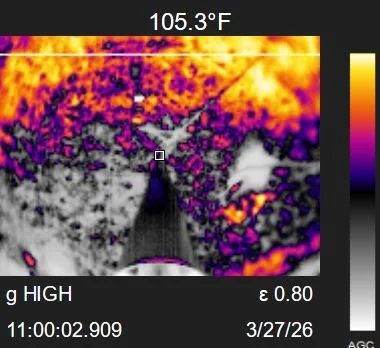
8 am
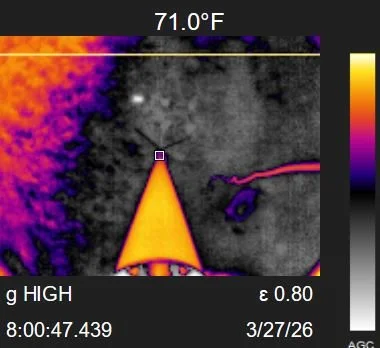
12 pm
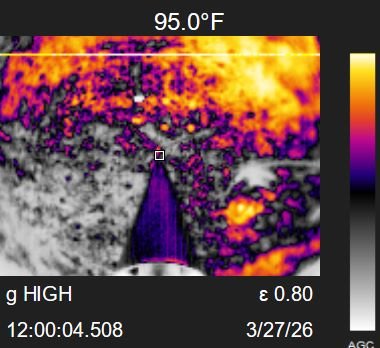
9 am
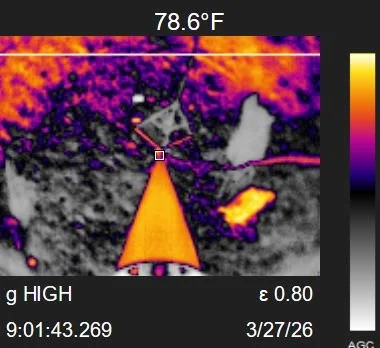
1 pm
10 am
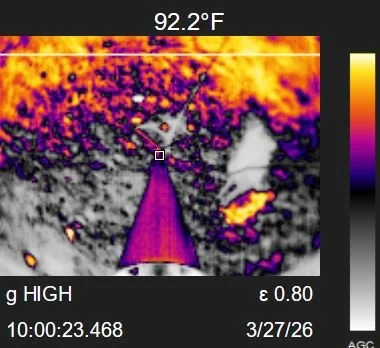
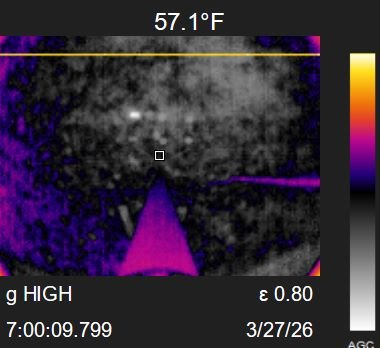
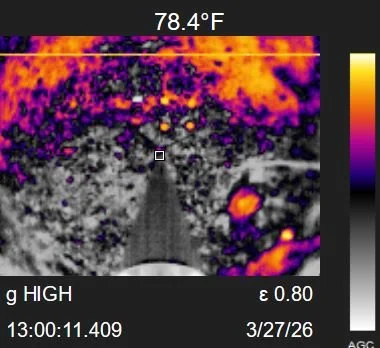
This test was conducted differently to the previous tests. It was conducted with only 6 test specimens, 2 of each material, with one painted and one unpainted. The camera is pointed 90 degrees down to not affect the temperature readings. Images were taken every hour on the hour from 7 am to 1 pm. The test was meant to last until an hour after sunset, but weather and technical concerns cut it short. The images showed that the test mines were much more distinctive starting at around noon and surprisingly early in the morning as well. This was contrary to our initial hypothesis that the mines would be most visible closer to sunset. However, this new data would seem to match our simulations discussed later on.
March 29th, 2026
Temperature at time of testing: 47°F
Feels like: 44°F
Humidity: 74%
Precipitation: 0-inches
Sunrise (CST): 6:47 am
Sunset (CST): 7:14 pm
Test Time: 6:25 pm
Pressure: 30.39 inches of mercury
Grass height: 4-inches
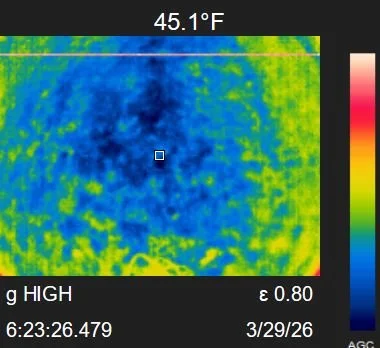
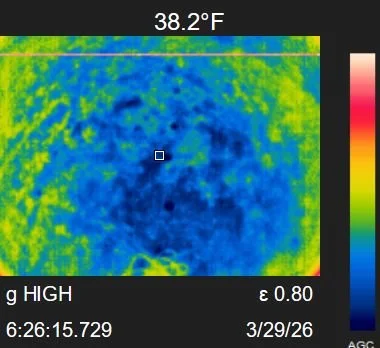
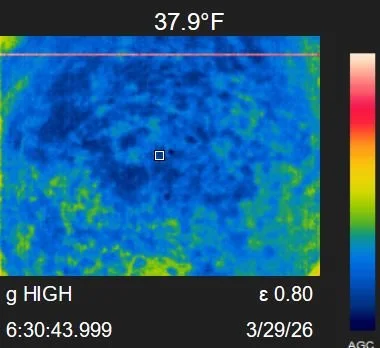
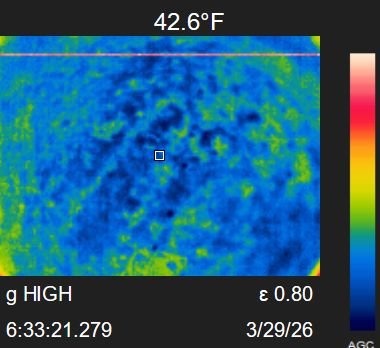
This test was conducted similarly to the initial tests. However, this test was conducted close to sunrise, to see if there was a discernable difference in image clarity between sunrise and sunset conditions. The mines in Site 1 were left overnight to simulate the mines having been laid the day before. The images above show that the mines seem to be about as identifiable as in the previous images taken at sunset. In some images, the mines seem to stand out even more than in the previous tests, however none stand out as clearly as they did in the March 27th test around noon. It should also be noted that this morning was much cooler than the last several tests, around 47°F, which could have contributed to any added visual clarity.